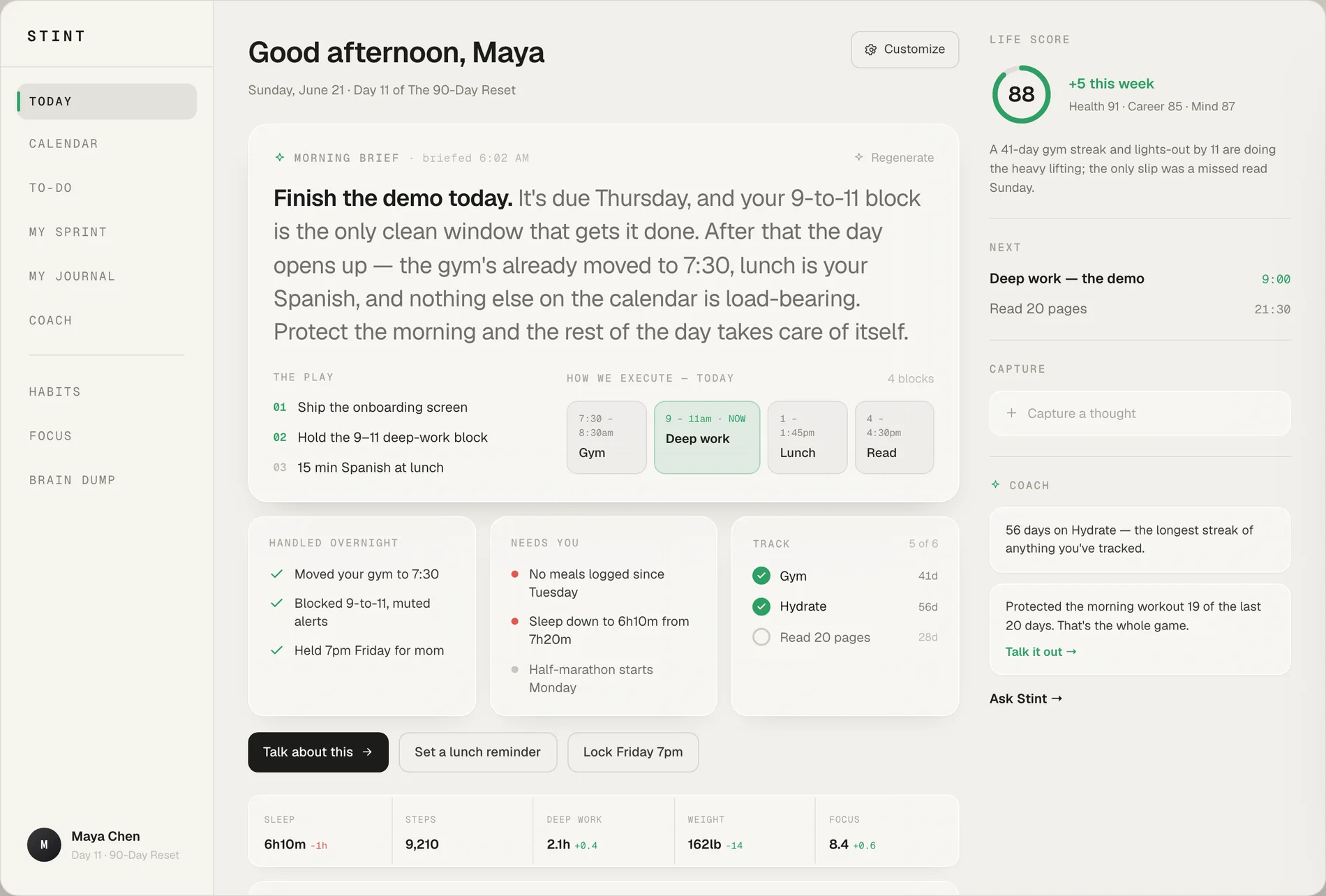
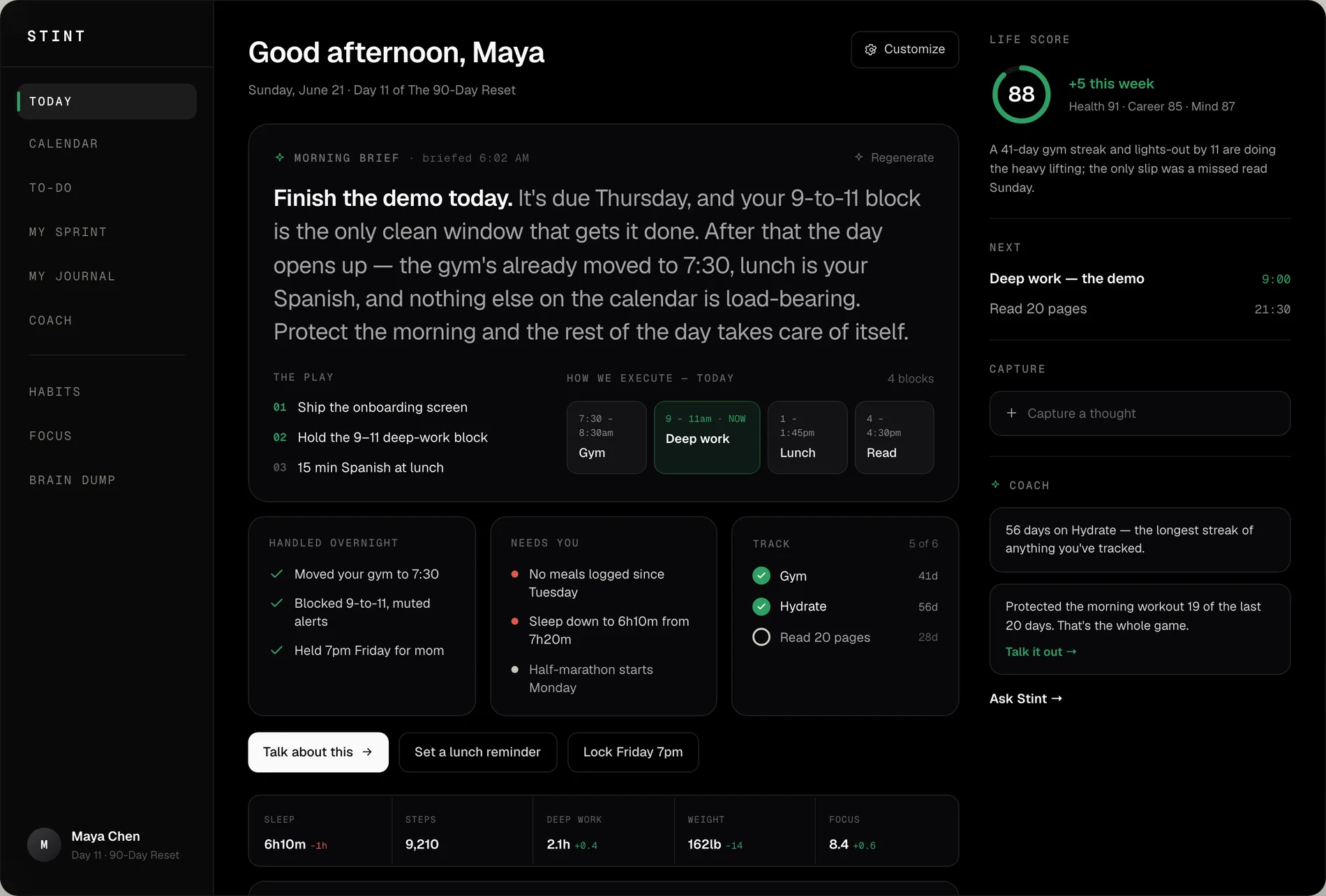
The daily brief
Open to one screen. Know your next move.
Every morning Stint reads everything you’ve logged and hands you the brief: what to do, why it matters, and what to skip. Do it, close the app, go live your day.
The others optimize your job. Stint cares about the whole of you: your health, your goals, the dream life you keep putting off. Then it plans it and runs it with you, every day.

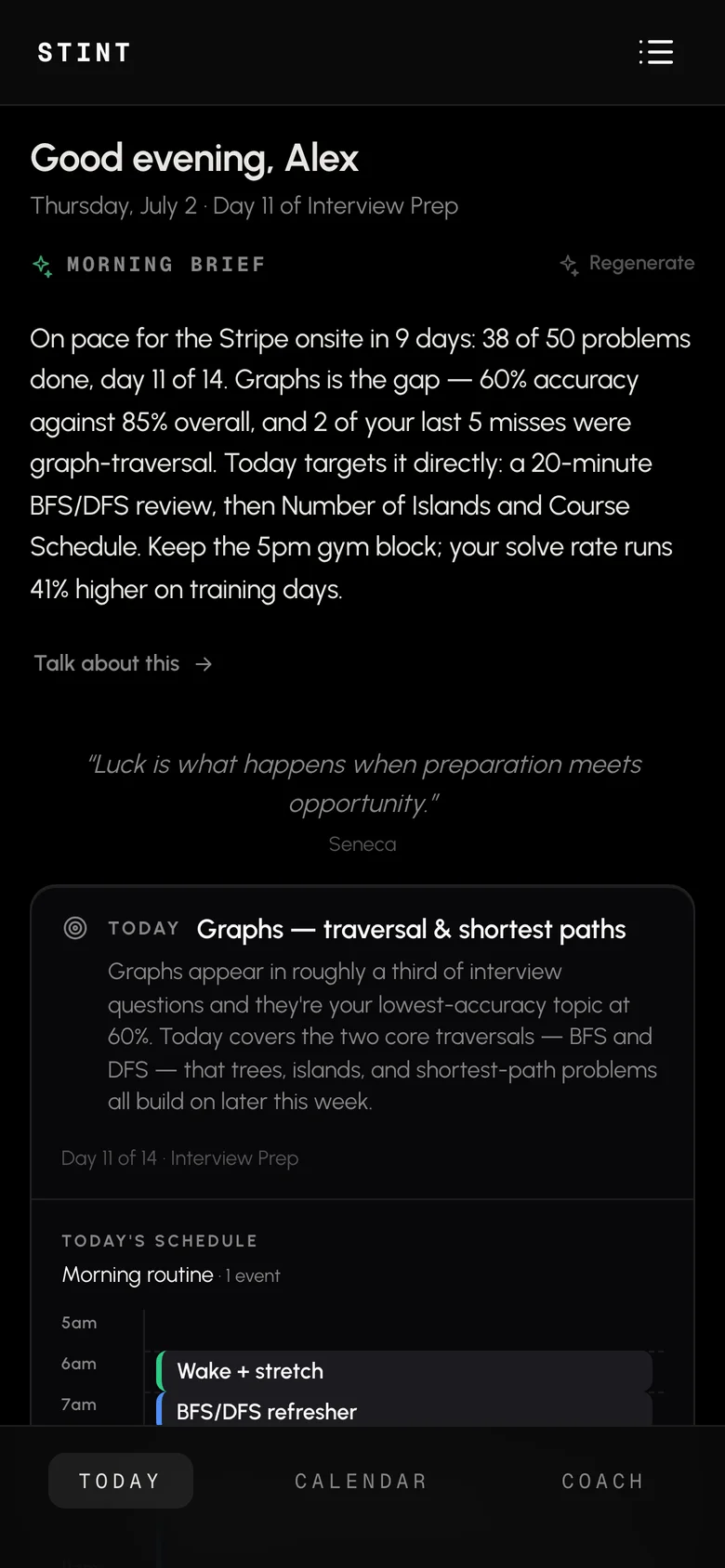
See it work
Not a mockup. The actual product, reading your real life and turning it into a plan you can run today.
Every morning Stint reads everything you’ve logged and hands you the brief: what to do, why it matters, and what to skip. Do it, close the app, go live your day.
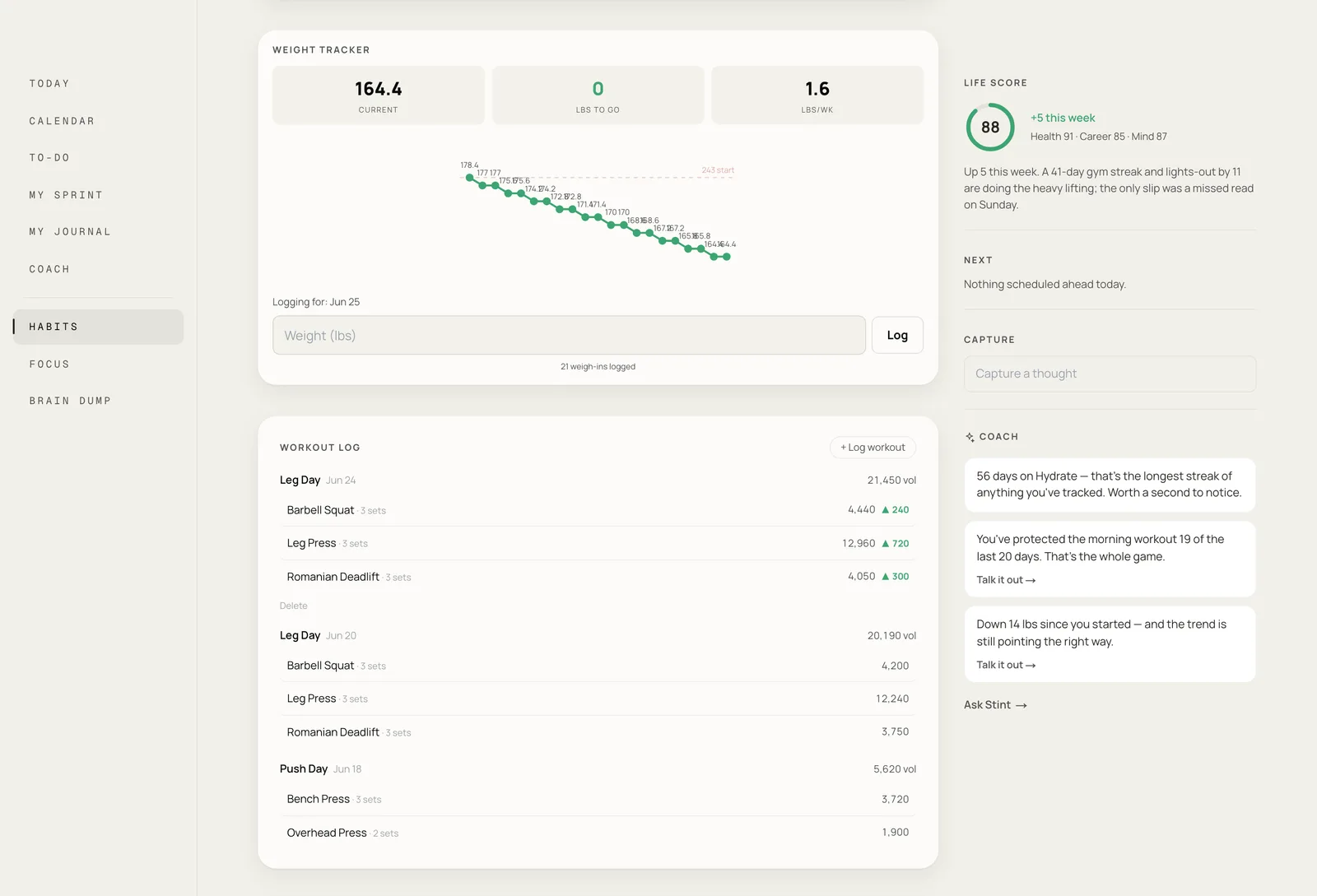
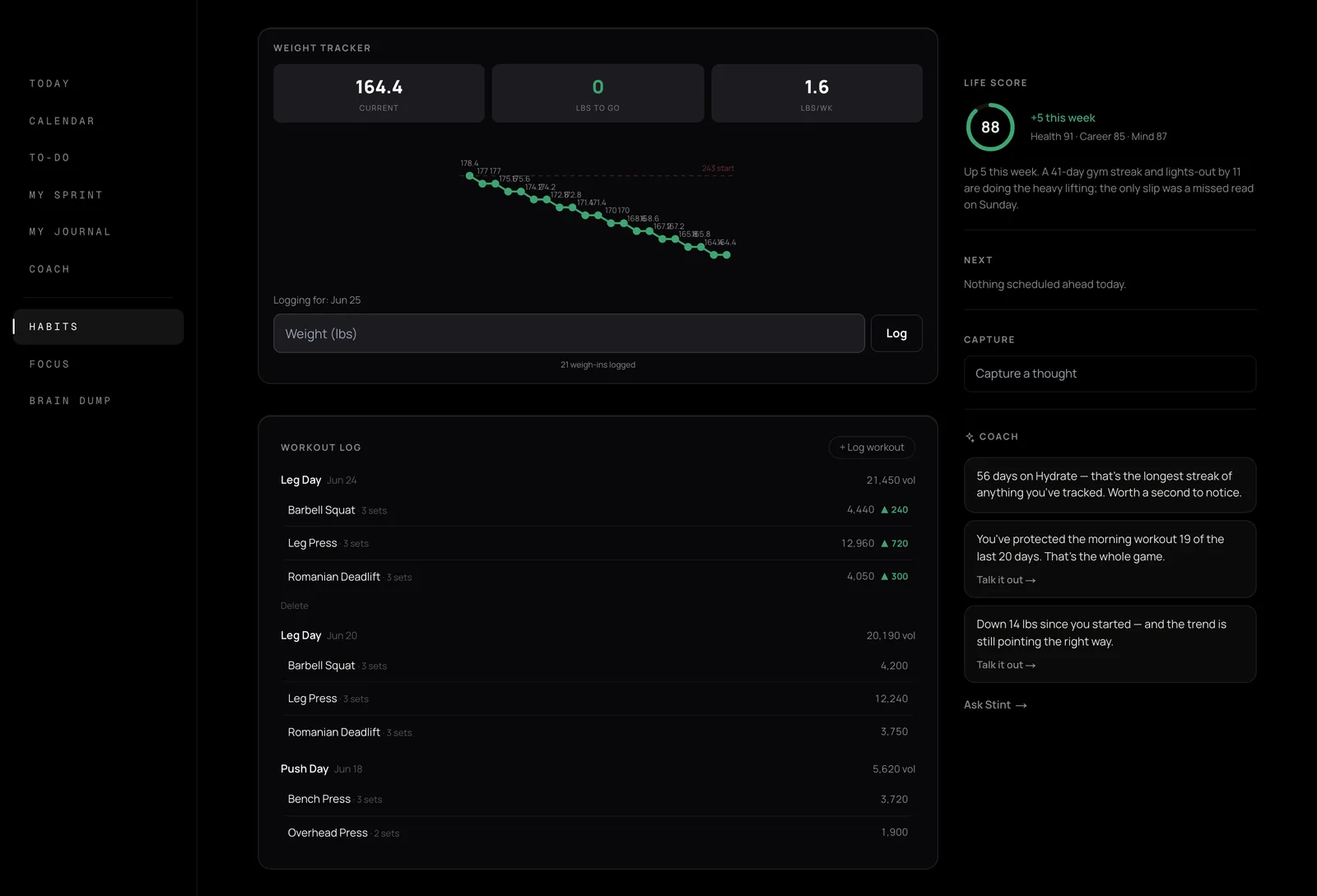
Workouts, macros, weight, habits: you log it, the coach reads it, the plan adapts. Beat-last-session volume deltas, streaks, and a weight trend that keeps you honest.
Pick a goal
Tell Stint the goal. It returns the diagnostic, the path from a year down to today, and the exact two weeks ahead, then adapts it to your real data. Five very different goals, one engine.
“Land a senior engineering role in 10 weeks.”
Not a raw-ability problem, a pattern-latency one. You can solve a graph problem in 40 minutes; you can’t yet recognize it’s a graph problem in 60 seconds. A 45-minute interview punishes exactly that, so we train recognition, not just solving.
Land and ramp into a senior role at a top-tier company, signed within 4 months, a strong performer by month 12. The interview is base camp, not the summit.
Graphs at 85%+, DP archetype-recognition at 80%+, ~120 problems with a live mistake log, and 5+ full timed mocks. Convert the loop to an offer.
Close the graph gap completely and build DP from the ground up. Pattern-recognition under 60 seconds on 80% of problems by month-end.
28–34 targeted problems on exactly your two weak areas, daily timed reps, a spaced-review loop on past misses, and a mock at the midpoint and the end.
Number of Islands (200), Flood Fill (733), Max Area of Island (695). 90 min, each timed. Why here: the first win on your weakest topic breaks the avoidance loop.
Front-loaded to your two weak topics while runway is long. Tap any day. Tap any day.
Your solve accuracy dropped to 58% on Days 4–5, both the morning after a night with zero logged sessions. So Stint flipped your schedule from one 90-min evening block to two 45-min blocks, one at 7am, and moved your hardest topic out of the post-skip slot. Your data says a trained day is worth a 41% swing.
4 of your last 6 graph misses were the same trigger: every “prerequisites / dependencies / ordering” problem, you reached for plain DFS and missed topo-sort. So tomorrow’s set became three more topo-sort problems, and a recognition card got pinned to your Today screen. This wasn’t in the plan. Your mistake log wrote it.
“Break 90, and make it stick.”
The real problem is your wedge and putter, not your driver. You’ve been grinding the 2-stroke problem and ignoring the 10-stroke one.
Handicap from ~18 to ~12–13, a verified sub-90 round (86–88) in the books, and a repeatable, pressure-proof short game.
3-putts down from 5 to ≤2 a round; up-and-down rate from ~10% to ~30%. Groove contact and lag distance, the fastest ROI.
Move to ~50% short game / 30% putting / 20% full swing. Clean contact on 9/10 chips; lag every putt inside 3 ft.
Low-point control + a wedge clock for chipping; gate + ladder for putting. Two rounds on bogey-golf strategy, counting doubles.
50 chips with the 56°, towel 6 inches behind the ball, your #1 stroke-saver. Then ladder putts to 15/30/45 ft, nothing left short.
4 short sessions a week plus 2 weekend rounds: 50% short game, 30% putting, 20% full swing. Tap any day.
Stint caught that 9 of your last 11 lag putts finished short, avg 4.5 ft, yet your 6-ft make rate is a healthy 70%. So we flipped practice from the gate to the ladder, with one rule: every lag must finish past the hole. Your stroke is fine; your speed is timid.
Stint noticed you logged 6 doubles on Saturday: 5 started with a greenside chunk or short-sided chip, zero with a tee shot. So we cut range time to one session and moved that hour to the towel drill. The scorecard says your wedges cost you the round.
“I have the heart of a 4:05 marathoner and the legs of an 8-mile runner.”
The real problem isn’t speed, it’s durability. Your engine is already faster than sub-4:30 needs, but your legs, tendons, and fueling have never seen mile 18.
Built on a base that never drops below 25 mpw. The first finish makes the second a tune-up, not a leap.
The 18-week build: mileage 15 → 38, longest run 8 → 20 mi, across four phases with non-negotiable down weeks.
Each 4-week block has ONE job: run 5 days without soreness, hold tempo for 4 miles, or finish a 20-miler with gas left.
Two weeks: one building long run, one threshold session, a VO2 touch, easy volume, and two strength days.
6 mi with 3×1mi @ 9:40, the workout that makes goal pace feel easy. Warm up fully; hit 9:40, not faster.
Weeks 5–6, ~22–26 mpw. Marathon-pace work enters your life. Tap any day.
Stint noticed your last 6 easy runs averaged 10:30/mi, not the prescribed 11:00, and resting HR ticked up 4 bpm. So we flipped Thursday to a hidden Zone-2 HR cap (≤145 bpm) and dropped tomorrow’s volume by 2 mi. Easy means easy, enforced.
Your last two long runs drifted from 10:50 to 11:40 in the final third, right at the 90-minute mark, a textbook fueling bonk, not a fitness limit. So we switched fueling to a gel every 35 min from mile 3 and added a watch reminder. The fix happens now, not on race day.
“From near-zero to a confident 30-minute Spanish conversation in 6 months.”
The real problem is allocation, not talent. 45 min/day of multiple-choice tapping built the weakest, most passive skill, while logging zero hours of listening and real speaking.
300+ input hours, comfortable hour-long conversations, Spanish-subtitle TV, the Monterrey supplier call handled solo.
45–60 comprehensible-input hours, the top 625 words active in Anki, all 90 Language Transfer lessons done, first tutor call by week 2.
~20 input hours, Anki habit locked at 10 cards/day, Language Transfer through ~lesson 40, 2–3 tutor sessions done.
The daily loop running 7 days, first iTalki lesson on Day 5, phone switched to Spanish, first podcast and show queued.
Clear 14 reviews plus 10 new cards, watch 2 Superbeginner videos with no English subs, and book tomorrow’s first tutor call now.
Daily 45-min loop: Anki 10m · Language Transfer 10m · comprehensible input 20m · shadowing 5m. Tap any day.
Stint caught your reviews spiking to 62 due cards on Day 9, completion dropping to 70% two days running. So it flipped new cards from 10/day to 5 for the rest of the sprint and moved Anki after your input block. Reviews stay sacred; intake bends so the guilt pile never forms.
Stint noticed you re-watched the same Superbeginner video three times and comprehension jumped from 60% to 95%. So it bumped your feed up to Beginner and surfaced Español con Juan as a stretch. You move up the moment your data says you’re ready, not on a fixed calendar.
“From bouncing off Crime and Punishment to genuinely well-read in a year.”
The problem is mechanical, not willpower. You start with the wrong book, read passively, and read exhausted at bedtime with no structure.
Homer to Camus, read actively with notes. A commonplace book of 200+ entries and a finished, understood Crime and Punishment.
Works 1–4: Odyssey, Oedipus, Plato, Aeneid. The real goal is installing the system, not just four books.
One epic in ~3 weeks at 20 pages a day, with 15+ commonplace entries. Prove the system works on yourself.
Fourteen days through the journey-out half: the Cyclops, Circe, the Underworld, the Sirens. A win you actually achieve.
“Tell me about a complicated man.” ~18 pages, ~22 minutes, read at 7:10am, then one line and two sentences in your commonplace book.
The Odyssey, trans. Emily Wilson. Books 1–12 in 14 days. ~30 min daily: read, then a 5-min reflection. Tap any day.
Stint noticed your last 4 sessions all logged after 10:40pm: three under 12 minutes with no entry, the signature of reading two pages and falling asleep. So we flipped your block to 7:10am and dropped the target from 25 to 18 pages until the morning habit holds.
Stint noticed you spent 38 minutes on the Underworld, nearly double your average, and your entry just read “too many names.” So instead of pushing on, we inserted a 20-minute re-anchor day with a lecture and a who’s-who, turning a quit-risk into your favorite chapter.
What Stint does
No buzzwords. Here's exactly what it does today, and what's landing in the beta.
Your AI coach
Plan your day
Track your life
Focus & mind
Connected Soon
Connect your whole life so it actually knows you, with no manual logging.
Everywhere & yours
Stint is in invite-only beta. The first 150 founding members get a free week when their invite arrives, an early-access head start, and the founding price locked for life, well below what it'll cost later.
What this costs in real life
Stint is all three
from $2.31/week
One app. A rounding error on what the humans cost.
Market rates shown are illustrative. Stint from-price is the annual plan's weekly equivalent.
Core
$2.31/week save 42% $3.99/week
Billed annually: $119.99/yr
Billed $3.99 every week, cancel anytime
For daily momentum.
Lighter coaching · no integrations
Start with CoffeeFounding rate
$5.77$4.42/week save 37% $8.99$6.99/week
Billed annually: $229.99/yr
Billed $6.99 every week, cancel anytime
Your coach reaches out first.
Everything in Coffee, plus:
Locked for life · Standard is $8.99/wk · $299.99/yr after founding
Claim your founding spotFounding rate
$17.29$13.44/week save 33% $24.99$19.99/week
Billed annually: $699/yr
Billed $19.99 every week, cancel anytime
Stint runs the system with you.
Everything in Full, plus:
Locked for life · yearly Premium is web-only · Standard $24.99/wk after
Lock the founding rateYour invite comes with a free week, no card needed. When billing begins, you keep the founding rate you locked.
FAQ
Your invite comes with a free week, no card needed. After that, founding members keep the rate they locked for good.
Live now: the coach, your daily brief, AI-built sprints, and the full command center: tasks, habits, calendar, goals, journal. Rolling out through the beta: the morning brief that reaches out to you. On the way: calendar and health integrations, text and push, and a single Life Score. We’ll always tell you which is which.
You decide what the coach can see. Mark anything private, and “forget this” genuinely removes it. Your data is yours, never sold, and you can export or delete it whenever you like.
By email, about your access. That’s the whole of it for now. Texts are optional and still to come. You can unsubscribe from anything in a single click.
The first beta lives on the web, with your daily brief delivered by email. Mobile and proactive messaging are next.
You hold a seat. We reach out as access opens, and you begin with a short, sharp onboarding: a few minutes of real conversation, and Stint already has a genuine read on you.
The first beta is 100 people. You'll be among the first to run your life on Stint, and you'll shape what it becomes. Joining costs nothing.
All 150 seats are taken. Join the waitlist and you'll be first in line when the next round opens.